
The 2026 Geopolitical Energy Shock and the Imperative for Domestic Fuel Alternatives
THE UPDATE
TYROIL
3/16/20263 min read
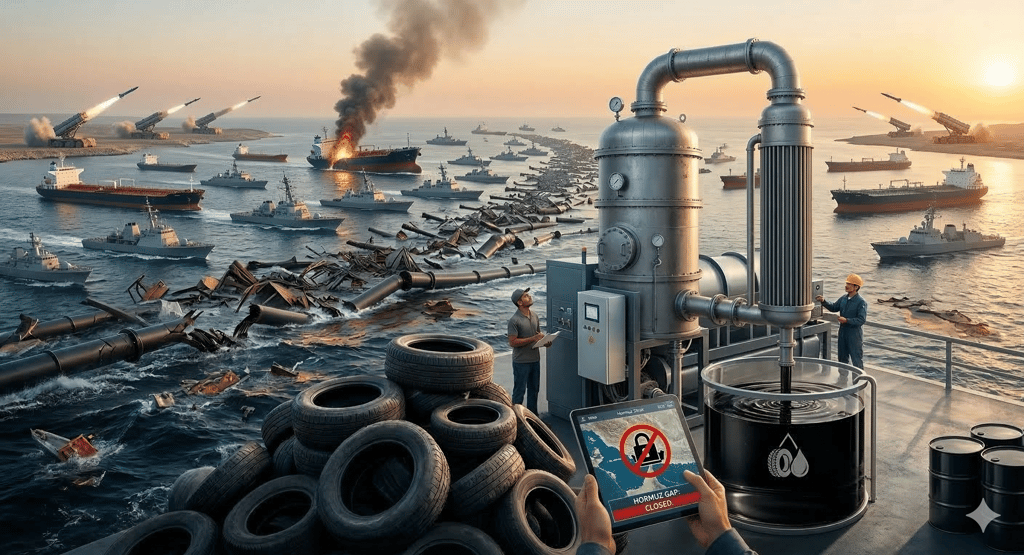
The global energy market is currently experiencing what the International Energy Agency (IEA) has explicitly designated as the most severe structural supply disruption in the history of global oil trading.¹ The rapid escalation of hostilities between the United States, Israel, and Iran, punctuated by the opening joint air strikes on February 28, 2026, and subsequent regional retaliations across the Middle East, has fundamentally destabilized the macroeconomic equilibrium of fossil fuel dependency.¹ Unlike localized skirmishes or proxy conflicts of the past decade, the current theater of war directly implicates the Strait of Hormuz, a critical maritime chokepoint that is functionally the jugular of the global economy. This narrow sea passage is responsible for the transit of approximately 20 million barrels of crude oil and refined oil products per day, alongside roughly one-fifth of the entire global liquefied natural gas (LNG) trade.³
As of March 2026, the Strait is considered functionally impaired by global maritime insurers, shipowners, and energy traders, triggering a severe cascade of war-risk premium repricing, rerouting, and outright transit cancellations due to the threat of missile and drone kinetics. The immediate market reaction to this structural shock was visceral. Brent crude futures surged by 15% in the opening days of the conflict, rapidly breaching the psychological $100 threshold and ultimately surging to $120 per barrel as the market began pricing in the risk of sustained, multi-year disruption.² Furthermore, the sharp slump in Middle Eastern production, driven by damaged oil infrastructure and full local storage facilities, has led the IEA to project a global oil output deficit plunging by 8 million barrels per day in March 2026 alone, far exceeding the concurrent demand destruction caused by reduced regional refining and commercial air travel.¹ While previous geopolitical events—such as the 12-Day War in June 2025 or the Suez Canal blockage in March 2021—precipitated temporary price spikes that normalized upon the cessation of hostilities, analysts project that the severity and geographic spread of the current conflict could sustain prices at or above $120, with worst-case scenario modeling predicting a surge to $150 per barrel.³
The economic fallout of this conflict extends far beyond the wellhead, internationalizing the costs of war and radiating through global commodity markets, industrial supply chains, and international food systems.³ For importing nations, particularly those in the Asian economic bloc, the burden is intensely asymmetrical and financially devastating. Major industrial economies rely heavily on the Middle East for crude imports; Japan relies on the region for 90% of its crude, while South Korea routes 95% of its Middle Eastern crude through the Strait of Hormuz.³ The severity of the crisis has already forced South Korea to activate a massive 100 trillion won ($68 billion) market-stabilization program to prevent systemic domestic defaults.³ Concurrently, the conflict has taken approximately one-third of the world’s helium supply off the market via disruptions at Qatar’s Ras Laffan hub, severely impacting semiconductor manufacturing, while fertilizer inputs like urea and ammonia have seen price increases of roughly 30%, threatening global crop yields and food security.³
In this highly volatile, inflationary environment, the strategic imperative for domestic, decentralized alternative energy sources has never been more acute. Indonesian industries, heavily reliant on conventional diesel and BioSolar for manufacturing, logistics, construction, and mining, remain highly exposed to these exogenous price shocks and the subsequent inflationary pressures. Herein lies the immense strategic value of localized waste-to-energy solutions. TYROIL’s production of Tire Pyrolysis Oil (TPO) provides an immediate, highly scalable domestic hedge against imported fossil fuel volatility.⁶ Because TYROIL's TPO is derived entirely from domestic industrial and consumer rubber waste through precise distillation processes, its raw material supply chain is inherently insulated from international maritime disruptions, global insurance surcharges, and foreign policy conflicts.⁶
By adopting TPO, industrial consumers effectively decouple their operational energy overhead from the unpredictable gyrations of the Brent crude index and the geopolitical instability of the Persian Gulf. The transition from imported commercial diesel to domestically synthesized TPO not only secures absolute energy continuity during times of global crisis but fundamentally alters the unit economics of industrial production, buffering heavy industries from the cascading effects of global inflation and securing long-term operational resilience.⁶
References
1. Oil Market Report - March 2026 – Analysis - IEA, accessed March 14, 2026, https://www.iea.org/reports/oil-market-report-march-2026
2. Middle East war creating ‘largest supply disruption in the history of oil markets’, accessed March 14, 2026, https://www.theguardian.com/business/2026/mar/12/middle-east-war-creating-largest-supply-disruption-in-the-history-of-oil-markets
3. The global price tag of war in the Middle East | World Economic Forum, accessed March 14, 2026, https://www.weforum.org/stories/2026/03/the-global-price-tag-of-war-in-the-middle-east/
4. How Will the Iran Conflict Impact Oil Prices? - Goldman Sachs, accessed March 14, 2026, https://www.goldmansachs.com/insights/articles/how-will-the-iran-conflict-impact-oil-prices
5. The War in Iran Will Raise Fuel Prices and Costs Throughout the Economy, accessed March 14, 2026, https://www.americanprogress.org/article/the-war-in-iran-will-raise-fuel-prices-and-costs-throughout-the-economy/
6. TYROIL TPO & Carbon Black : Solusi energi Berkelanjutan dari ..., accessed March 14, 2026, http://tyroil.co.id